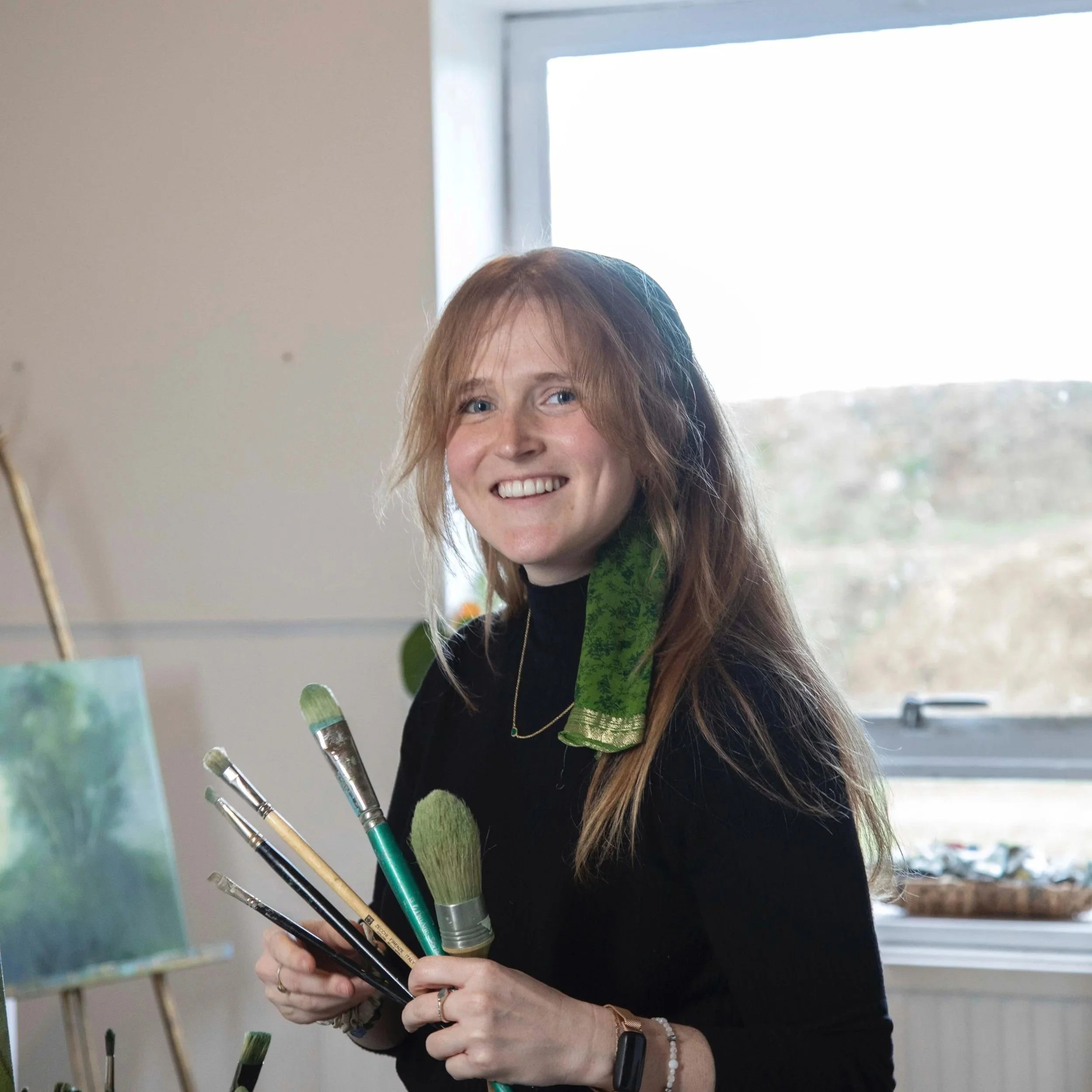
The heavens brought us good weather on a glorious Friday afternoon as my journey to leafy Dulwich led me to the doors of Bell House volunteer led charity in London. The occasion marked a milestone for British artist and practitioner Alexandra Oliver who debuted her first four-day solo exhibition ‘Viridis’ within the Georgian style setting.
Georgian homes have increasingly become a beacon of the British heritage sector operating in ways that diverge from the conventional gallery model. Bell House offers a glimpse into the repurposed historic home community framework driven by grassroots initiatives reshaping the role of London’s heritage sector. While 25% of the proceeds from the sale of Oliver’s paintings will go towards Bell House’s adult literacy charity for its readers.
Viridis which the exhibition lends its name in the literal sense, means green in Latin, green a colour synonymous with nature, botanicals and the symbolic mythos of Eden.
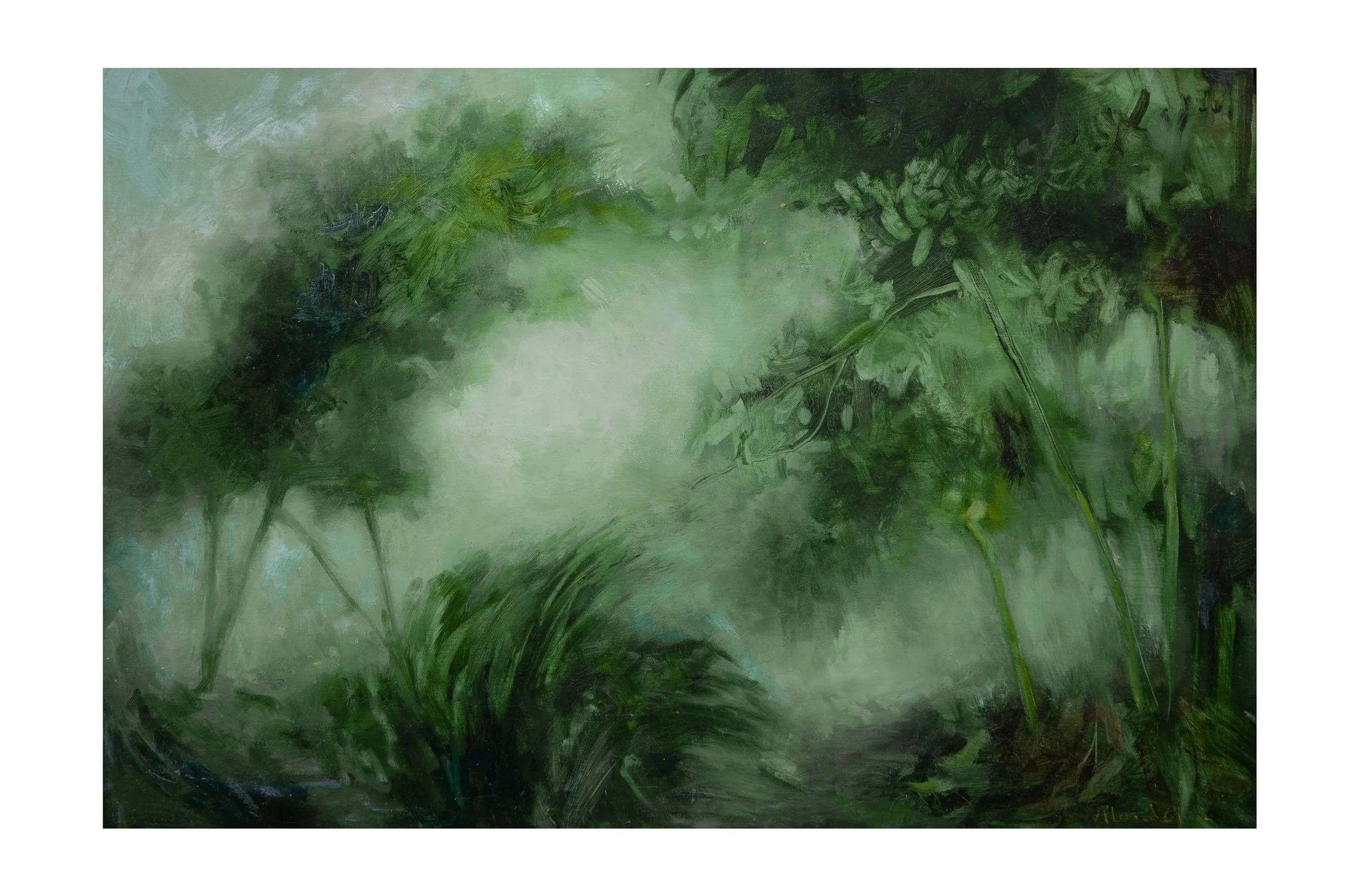
‘Viridis’, Oil on linen, Alexandra Oliver 2024
Fifteen works comprising of new and existing oil paintings alongside charcoal study drawings explore Alexandra’s response to the fervent, shifting ebb and flow of energy that course through the natural world. Channelled through the artists own memory and inherent connection to the woodlands of Suffolk countryside where she resides.
These body of works largely deliver on the promise of the chromatic etymology of green raising questions on what it means to experience nature through the body before it becomes an image? How memory shapes our understanding of place and how Romantic traditions speak to the contemporary idealised ecological experience? I also ponder on the long artistic argument that nature does not merely inspire art but actively informs it.
I notice that three of the works are hung above fireplaces situated in each space stacked with freshly chopped wood beneath them, a subtle gesture wrought by ecological precision. The glass double doors in one of main exhibition rooms is left open throughout the duration of the show extending onto the manicured garden surrounding the house. This curatorial decision by Lucy Macdonald is one of the exhibitions strengths. Sightlines from the rooms lead the eye outward through numerous gravel and woodchip paths, a veteran tree, a tulipwood log, and clipped grass encourages the viewer to look beyond the confines of the space and engage visually with the external environment informing the work.
In the artwork Viridis, (2024) the foliage in the painting is depicted well almost jungle-like, but not too precious, at the centre of work the paint has been scaled back to reveal an underlay of negative space. Feral leaves with soft natural lighting barely perceptible emanate from the foreground.
Elsewhere on the painting, the woodland foliage is conveyed as dense short tufts below, elongated strokes of varied green stalks extend from the left- and right-hand side of the canvas depict blades of grass, tree branches and splayed through the good use of shadows. This oscillation between erasure and mossy intensity creates a naturalistic surface, as if the woodland were continually reconfiguring itself before the viewer’s eyes.
What is immediately clear is Alexandra’s heavy reliance on the use of traditional fine-art medium particularly her use of oil paint as a vehicle to create gestural mark-making techniques using a limited colour palette (a nod to J.M.W Turner) to coalesce into a contemporary visual language. Her smaller study drawings are compelling and brimming with scratchy charcoal details these small iterations of her paintings are somewhat the Genesis of her final works. Function as 2-D maquettes of ideas that remain in motion before being memorialised in paint within her studio.
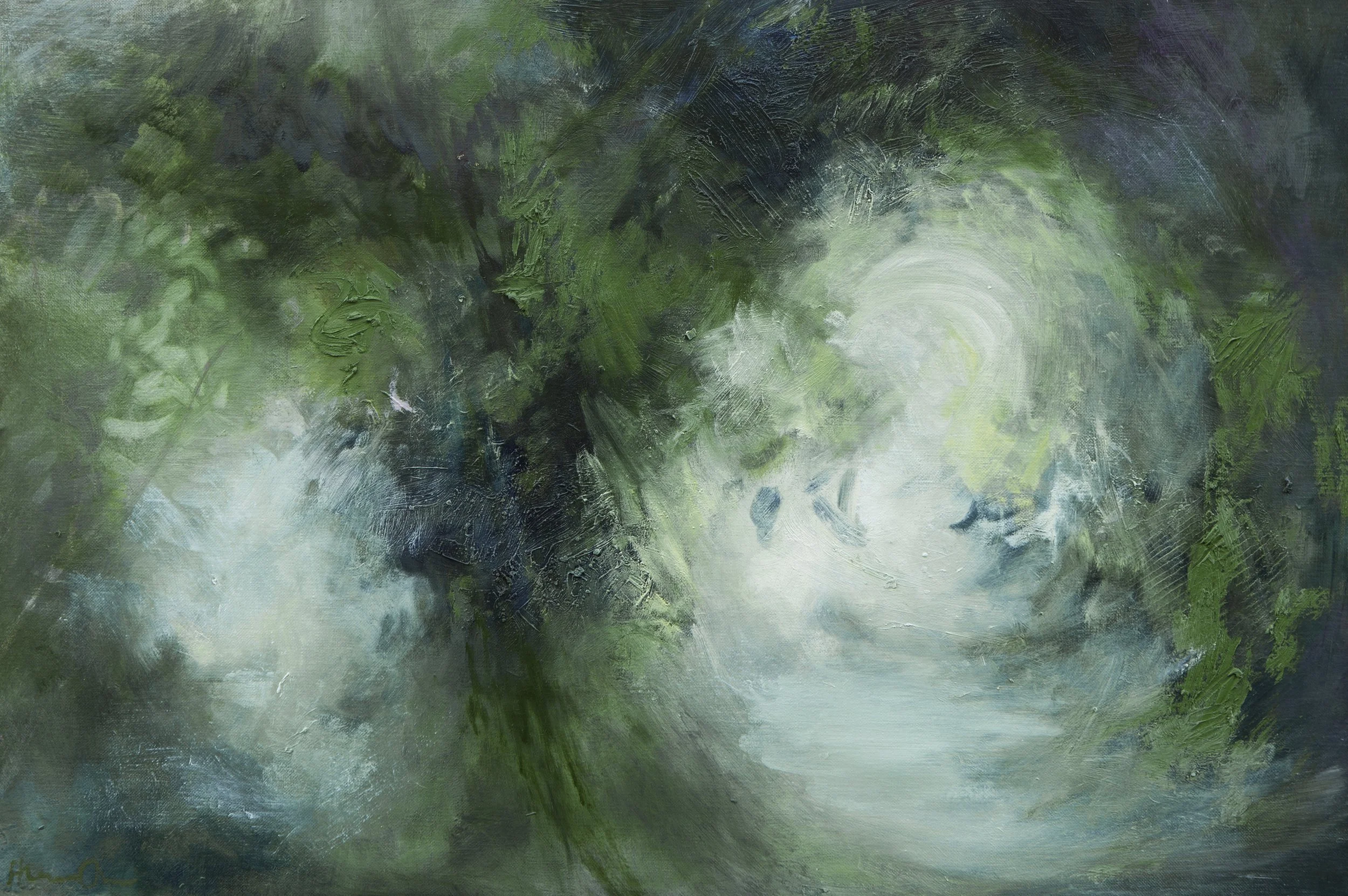
’Spirited’, Oil on linen, Alexandra Oliver 2025
Heavily inspired by the outdoors Alexandra uses walking as a creative methodology for memory, not as pastoral wandering nor as the dérive historically associated with avant‑garde practices. But as a contemporary, process‑driven approach.
The training of memory has been prevalent in the tradition in art education dating back to the Renaissance era, artists would practice drawing from memory so that the image was ingrained in their imagination. This was a crucial instance during the nineteenth century, with the move towards modernism. The human memory known to be a powerful machine; the blueprint of our consciousness and when we dream our unconsciousness. This is because the brain constantly modifies itself overtime due to our lived experiences with the physical world, which shapes us socially.
Whoosh! Like a mighty rushing wind enter ’Spirited’, (2025) this painting in particular has a remarkable fluidity for a not so large work. There is a strong sensory visage to both the elemental and architectural power of landscape here. Something about the underwhelming presence of sunlight sifting through the overarching leafy canopies illuminates the point at which two woodland paths split is quite sublime. Just off-centre of the canvas a single tree anchors the composition, a moment of stillness before the landscape opens out in two directions. Although there is no water source in the scene an atmospheric change in saturation created by the introduction of white, yellow and grey hues of colour suggest a clearing of air lifting the heaviness of woodland path into a pocket of brightness.
There is more of a heightened atmosphere in ‘Verdant Essence’, (2025) the work borrows many of the conventions of artworks from academic history painting era of British Romanticism J.M.W Turner’s, Snow Storm - Hannibal and His Army Crossing the Alps, (1812) and John Martin’s John Martin — The Destruction of Pompei and Herculaneum, (1821) springs to mind. The viewer must approach this work by looking through the luminous vortex openings while canopies envelop them. The work itself has many subtle elements of Martin’s dramatic skies and Turner’s tsunami‑like black clouds that blot out the sun.
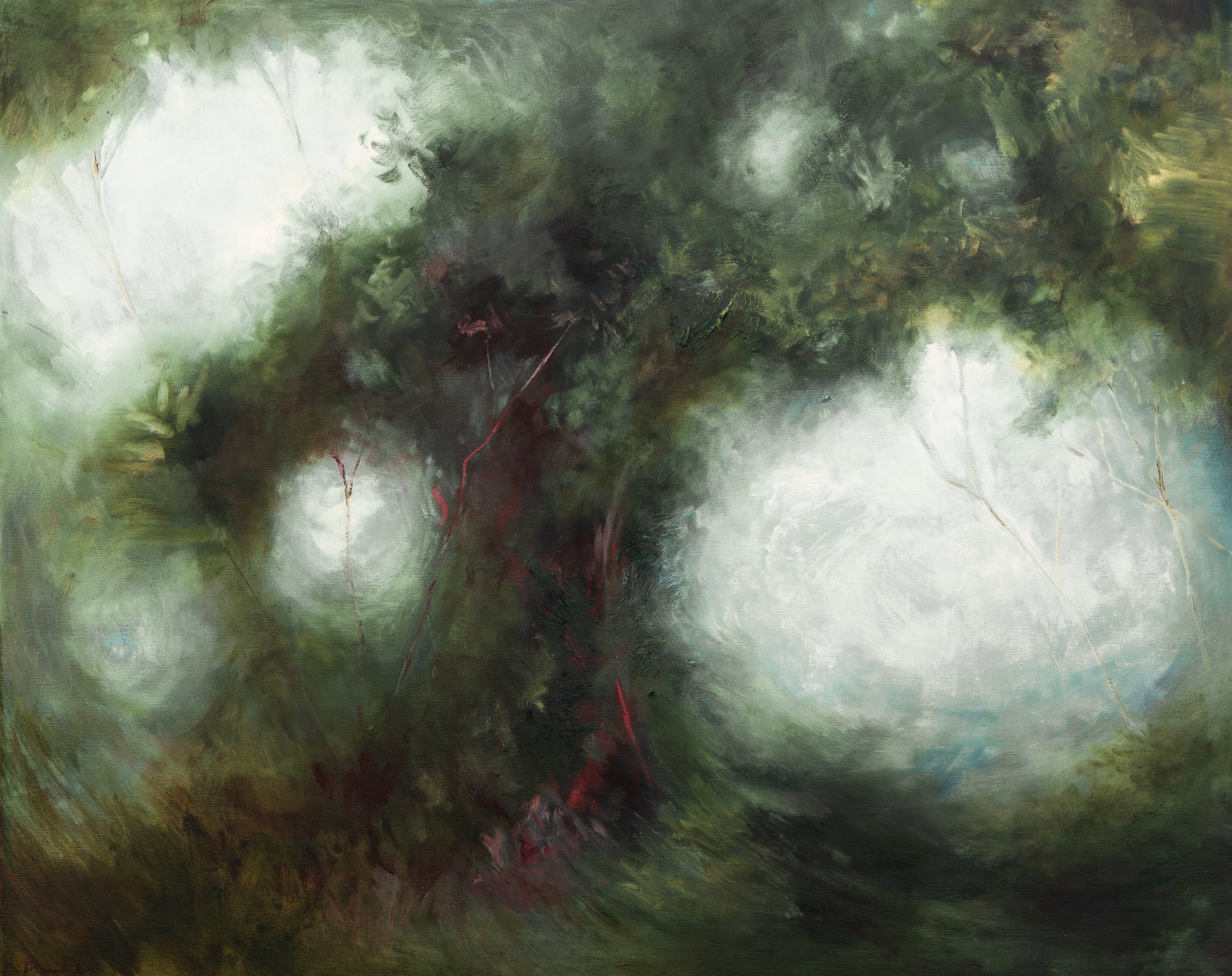
‘Verdant Essence’, Oil on linen, Alexandra Oliver 2025
Again, we are met with a tree heavily laden with vegetation partitions of greenery one broad path and five smaller openings puncture the atmospheric plane, each admitting a shaft of light that guides the eye deeper into the woodland. The ecology of the trunk is painted with more vigorous brushstrokes while shadows pool at its base. The tree never fully conceals the red underpainting beneath the painterly layers as; it radiates through the surface like a quiet source of heat.
In a world dominated by figuration, it is not often I encounter many landscape artists in present-day. Alexandra deliberately withholds any focal figures from the canvas, in doing so, redirects our attention to the agency of place itself. Her, organic concavities are striking and purposeful allowing the viewer to reconsider their relationship with the natural world and to attune themselves to re-experience nature as a living spiritual force there is much promise in this artist visual language.