On the eve of London Gallery Weekend, a new group exhibition co-curated by three of The Koppel Project’s emerging artists opened to the public at ANNEX. Located behind KOPPEL Heights in South-East, the ANNEX, a windowless exhibition and creative project space, has long supported early-career artists since its inception.
Liminal, which closed on the 11 June 2026, is the brainchild of three Iranian female artists: Aida Pouryeganeh, Kiana Azizmohammadi and Sahar Ravanbakhsh, whose practice has been shaped by a shared diasporic, culturogeographical history and collective curatorial vision. Liminal brings together recent works created between 2024 and 2026. Spanning painting, installation, sculpture, ceramics, time-based and mixed media to explore paradoxes shaped by surveillance, repetition, freedom and control. Having first met as students during their formative years at Middlesex University, their collaboration raises questions about artistic exchange and the resonant fluidity of authorship in contemporary art practice.
Throughout history, we have seen the role of the artist-maker evolve and blur with other vocations - such dual intersections: artist-as-curator, curator-as-writer, writer-as-educator, and so forth, have long been woven into the canon of Western art history since the founding of the Royal Academy of Art in 1768.
There was a poignant moment in Aida Pouryeganeh’s account of her practice when she described realising, almost against her own intention, why she had chosen not to stretch her canvases or paint the corners. It was not a theoretical decision arrived at through art school. It came to her in the act of working when the thinking mind steps aside. It was because “all the important things are in corners” the place where the things happen quietly, unannounced. Through the margins of her own life, arriving at self: talking but nobody listens, playing piano and nobody listens she offers this not with bitterness but with something closer to acceptance, even with a kind of freedom, the unwillingness to perform completeness on demand.
It is the corner - her natural habitat asserting itself across the entire surface - what appears to be gesture is also, subconsciously autobiography.
At first glance, Aida’s monochromatic painting ‘Untitled’, (2024), appears to align within the rubric of American post-war abstraction. Where gesture and action were regarded as, trailblazing acts, such a reading invites an allied, prototypical cross-examination of artists from that time, particularly the New York School, which dominated the arts scene in the 1950s following the interwar years.
It is not so much a matter of comparison: the choreographed drips of Pollock and the fervent graphic score of Kline are the visual echoes I live for. Over the past decade, Aida has committed herself almost exclusively to using paint as her preferred medium, even more so after she decided to renounce colour from her works in favour of a black and white palette. By eliminating the distractions of colour, she establishes the necessary conditions to destroy the perfect white surface. This clarity is conveyed through her material decisions: a conscious affinity for monochrome a rejection of excess and freedom outside of conventional limits.
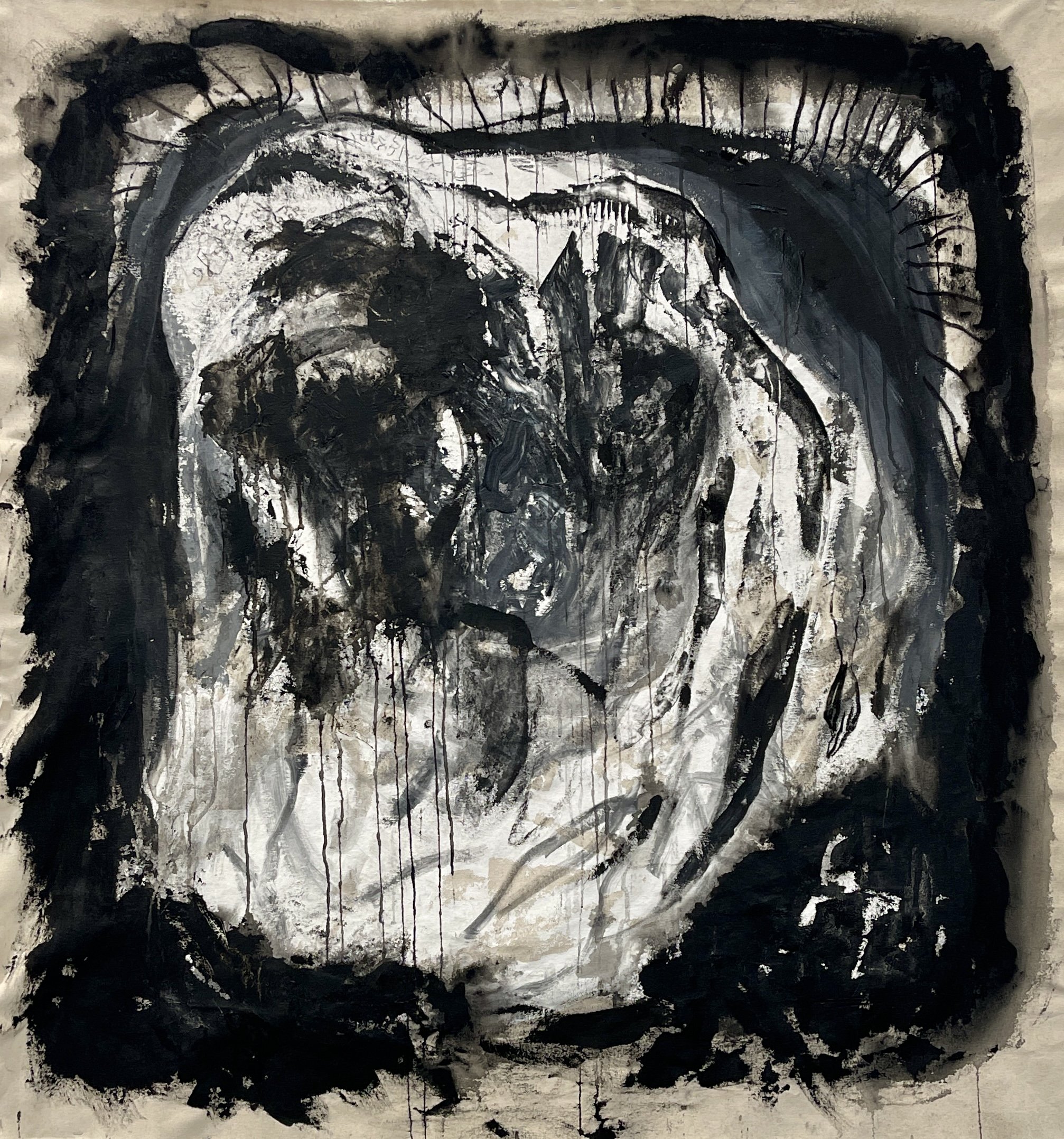
‘Untitled’, acrylic and charcoal on canvas, Aida Pouryeganeh, 2024
A dense application of black paint encircles a central field of white in ‘Untitled’, (2024), the said medium appears to have been applied in at least three temporal layers. The topmost layer of black paint churning into the white creates a slight amalgamation of grey - drawing colours from opposites sides of the colour spectrum into proximity. There is a heavy square border of deep black encasing the central abstract mass within this frame the centre is destabilising.
Yet, neither extends fully to the canvas edge, leaving the raw fabric exposed – material that would conventionally be folded away and hidden to the viewer. There is something precisely cutting-room floor about this exposure: we are witnessing not just the finished work but its underside. The softer, smudged charcoal notes have a dusty quality making the work appear graphic but it’s not the dominant medium here. There is an insistence that something is emerging and being partially concealed; the gestural vocabulary reminds me of early Kiefer, who perceived his work as a ‘call to memory’.
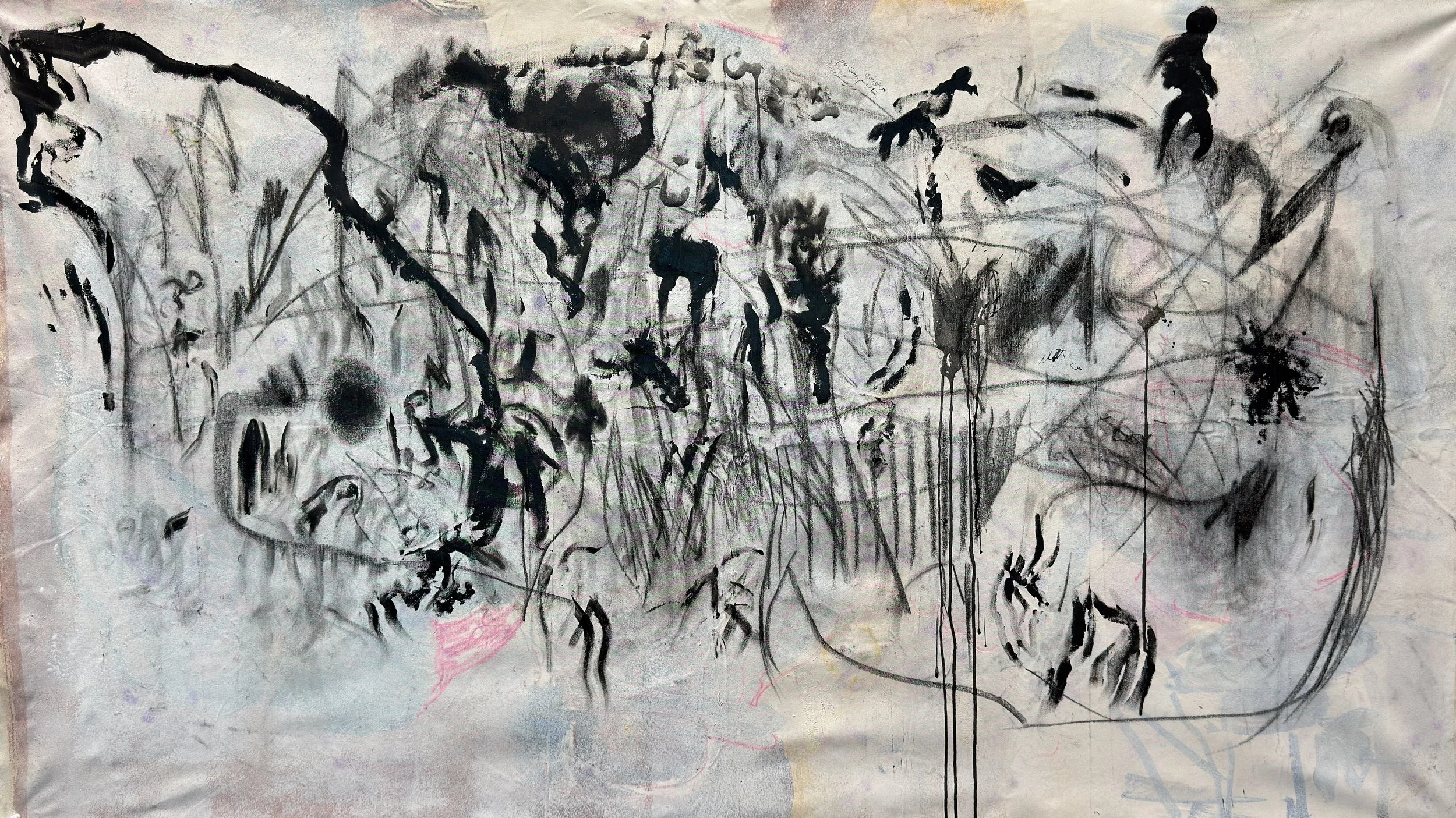
‘Untitled’, acrylic and charcoal on canvas, Aida Pouryeganeh, 2026
‘Untitled’, 2026 is a newer wide-scale work announces its intentions through sheer physicality: tactile strokes of charcoal and acrylic overlap the light chalky washes of pink and muted light undertones that make the background. The mark-making operates at three registers drawing, landscape and figuration simultaneously: something resembling a standing figure on the top right and other silhouettes manifest at the centre of the work, creating sequence of ascendence. I quite like the busyness of the execution as well as the scaled back of media the gestural strokes trace themselves.
Drips running vertically through the lower-right quadrant are not incidental; they perform gravity anchoring and otherwise weightless composition to material fact. This is very much in the line of process-conscious abstraction: Frankenthaler’s staining and De Kooning’s figural dissolution of Black Untitled. Perhaps the provisional mark is recalling the moment when the act of painting becomes a means of holding on to a thought before it slips from grasp.

‘Centred in the unseen’, charcoal and acrylic on canvas, Aida Pouryeganeh, 2024
Panopticon, later theorised by Michel Foucault in reference to modern prison systems, describes a structure in which one may observe others without being seen, suggesting that invisibility can become a form of surveillance. ‘Centred in the Unseen’, (2024), from her ongoing Panopticon series, addresses concerns of observation and surveillance through the heavy use of the hardened, translucent glaze and fervent, painterly strokes that partially cover the work. The slapdash application of black here is impactful but also isolating in its positioning on the canvas.
Implying closure and control that sit easily with her creative processes drawing the eye to the centre of the work: “I just start…I don’t really plan…I just do” leaving the canvas this way also allows it to remain open-ended as a field of ongoing action rather than a finished project, but is the artist's work ever finished? Aida reflects: “it gave me the feeling of a jail…am I the watcher, or am I the one watching?” This unresolved paradox sits at the core of the work, aligning her practice with the conceptual framework of the Panopticon: the viewer becomes entrapped upon encountering their own shadowy reflection within the sheen of viscousy glaze, as if in a prison within themselves. Rather than stage surveillance as a distant system, Aida encloses the spectator within the work; the viewer simultaneously becomes subject and object, watcher and watched.
Drawing on her experience between Iran and the UK, she observes that while forms of control may differ, they persist: “here, or all the other countries, they have their freedom, but…it’s a fake thing.” What emerges is a critique of both overt and covert systems of governance whether visible in enforced codes or embedded in subtle social expectations. “You are under control no matter where you are,” she concludes, framing surveillance as a global condition.
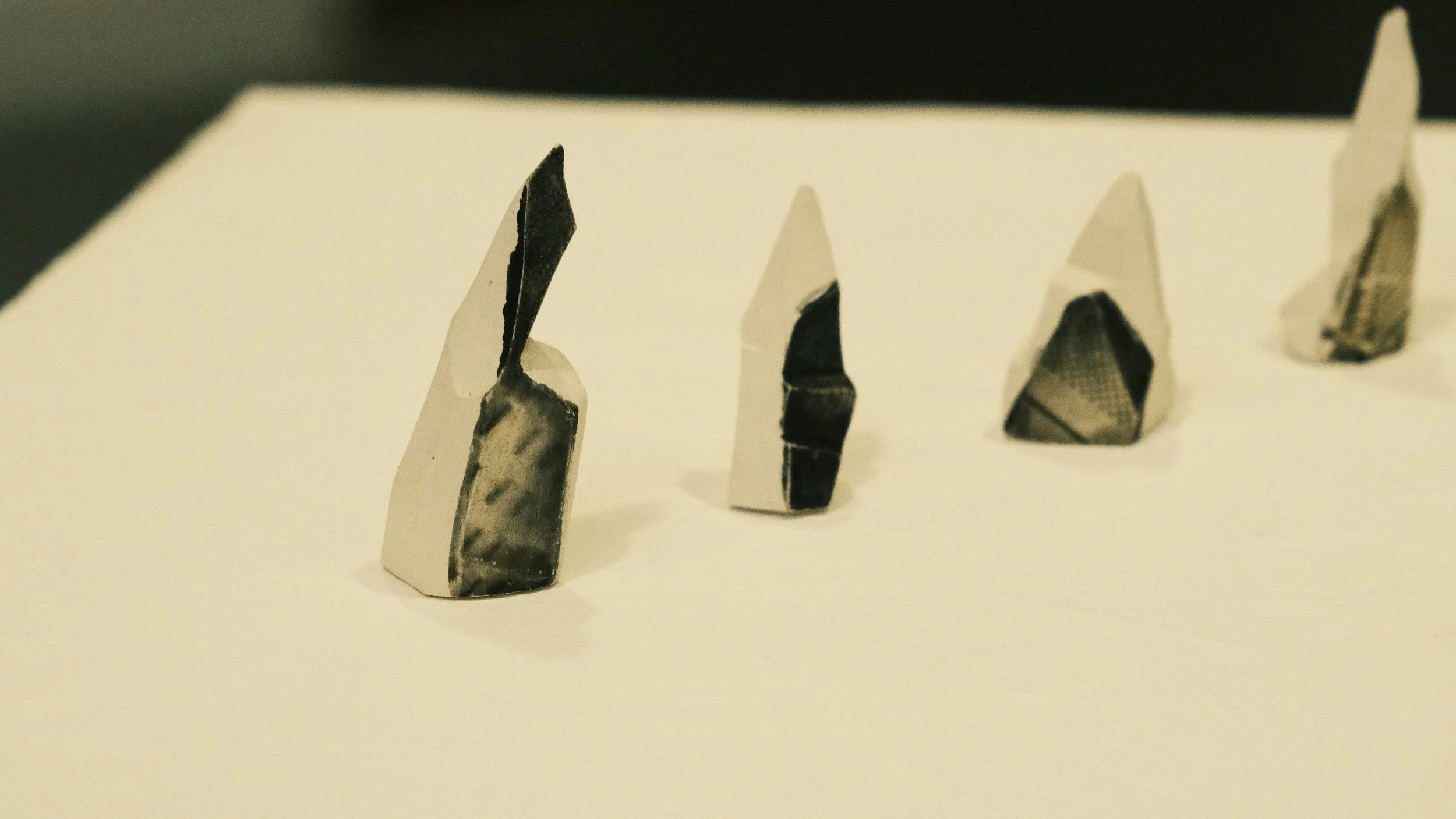
‘The Mountains I carried With Me’, handprinted analogue photography on ceramic (Series of 12), Kiana Azizmohammadi, 2025
Pedestalised on three plinths in a quiet line of procession, the miniature ceramic sculptures in ‘The Mountains I Carried with Me’, (2025) are small enough to put in your pocket and take with you, they look like rocks - but they are not, they are portable and there is an urge to touch them, but you cannot. The viewer must lean in to experience them but never permitted the closure of touch. Each irregular triangular peak varies in height, lean and inclination – recalling the mountainous terrain surrounding the Iranian city where she grew up.
Which she self-admittedly disliked living among – an inescapable backdrop that defined the locale as much as it confined it yet, in its absence, it returns differently. Having formally studied handicrafts in Iran, Kiana describes the transition from applied arts to fine art as a challenging one but also one of release.
What makes Kiana’s work compelling is the breadth of materials she incorporates within her work. “I tend to say I am a photographer,” she notes, - “I could be a bit more free. ”…” I find whatever I want and translate it into a different material” two languages – ceramic and photography merge into one another but also act as opposition one historically prevalent in many ancient civilisations - the other more recent there is anticipation predicated on whether the permanence of one medium can hold the other.
The act of transferring an analogue photographic image onto ceramic is technically precarious as you are dealing with multiple elements: a process of loss, light, chemicals then go through the process of imprinting the image. Many things can go wrong here as you cannot control what survives. Ceramic on the other hand is fragile but, also strong enough to withstand high temperatures. What is striking about these small ceramic relics is that you do not initially perceive them as mountains, but they bear the hand-printed analogue photographic images taken from her personal archive in a way I have never seen imagery used - rendered in soft greyscale and embedded in fragments directly onto the ceramic surface.
Charged with a latent indeterminacy: belonging to once place, calling another home and feeling estranged from both. Does the work attempt to preserve the mountain as it was, or to recreate under new conditions? Can something once rejected become meaningful only once it is no longer accessible? This series is a call to memorialisation of the past and present – where image and material fuse. The tension of in-betweenness could be read two ways: it’s as if the image has become fossilised, it’s not a physical site but a reconstruction of one shaped by memory and attachment of longing for one’s homeland and being estranged from it and memorialising a landscape you no longer inhabit by asking was I there? And am I still there despite being elsewhere.
For an artist working with themes of migration and carried memory, choosing ceramic was not merely practical. It was the argument.
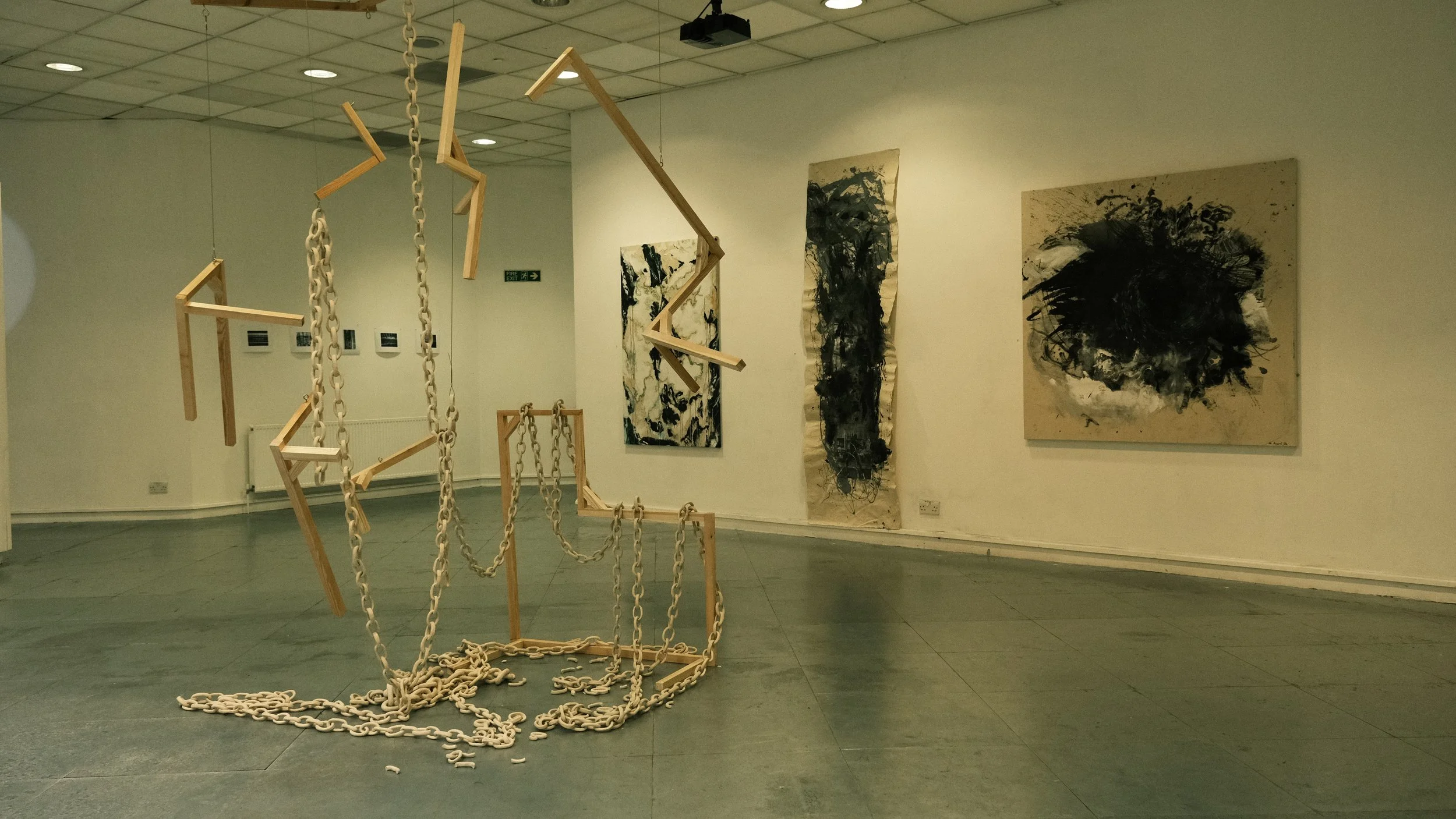
Installation view: ‘Untitled’, ceramic, wood, hanging wire, fishing wire, Kiana Azizmohammadi, 2025
The ‘Untitled’, (2025) installation is the 2.0 version of a previous work. In this rendition ‘Untitled’, (2025) presents a semi dismantled frame of a house – bare wooden frames – incomplete, skeletal, unjointed, no infrastructure suspended mid-air from the ceiling in their broken arrangement a configuration of domesticity: no rooms, thresholds or door, shelter no shelter what is considered a place of safety is no longer safe. The chains did not break by accident - Kiana broke them herself, in a single act of anger as a response to recent events in Iran.
From these frames they descend in their brokeness, pooling on the gallery floor where more broken links and shattered fragments scatter outward in their sheer quantities. Each link handmade individually, the accumulated labour lasting the majority of her master’s degree programme. The installation hold is between the extraordinary patience of making lots of individual ceramic links, each one formed by hand fired, linked – and the violence of their destruction.
I cannot help but think of Cornelia Parker’s ‘Cold Dark Matter: An Exploded View’ (1991) with this carrying on - where Parker detonated a garden shed then recreated it mid-explosion by suspending the exploded debris one by one within a space. Kiana inverts this logic: the ruin she has created is self-administered, where Parker freezes a single catastrophic moment. Kiana presents the aftermath of the break - all of the pieces left where they landed.
Months of meticulous labour end in a moment. Creation and chaos occupying and operating at the same, the ceramic chain implies a connection, things that bind, it is more brittle than its wooden counterpart. It can withstand damage until it cannot, reflecting the fragility of life.The broken fragments remaining on the floor, unswept is the works most honest decision.
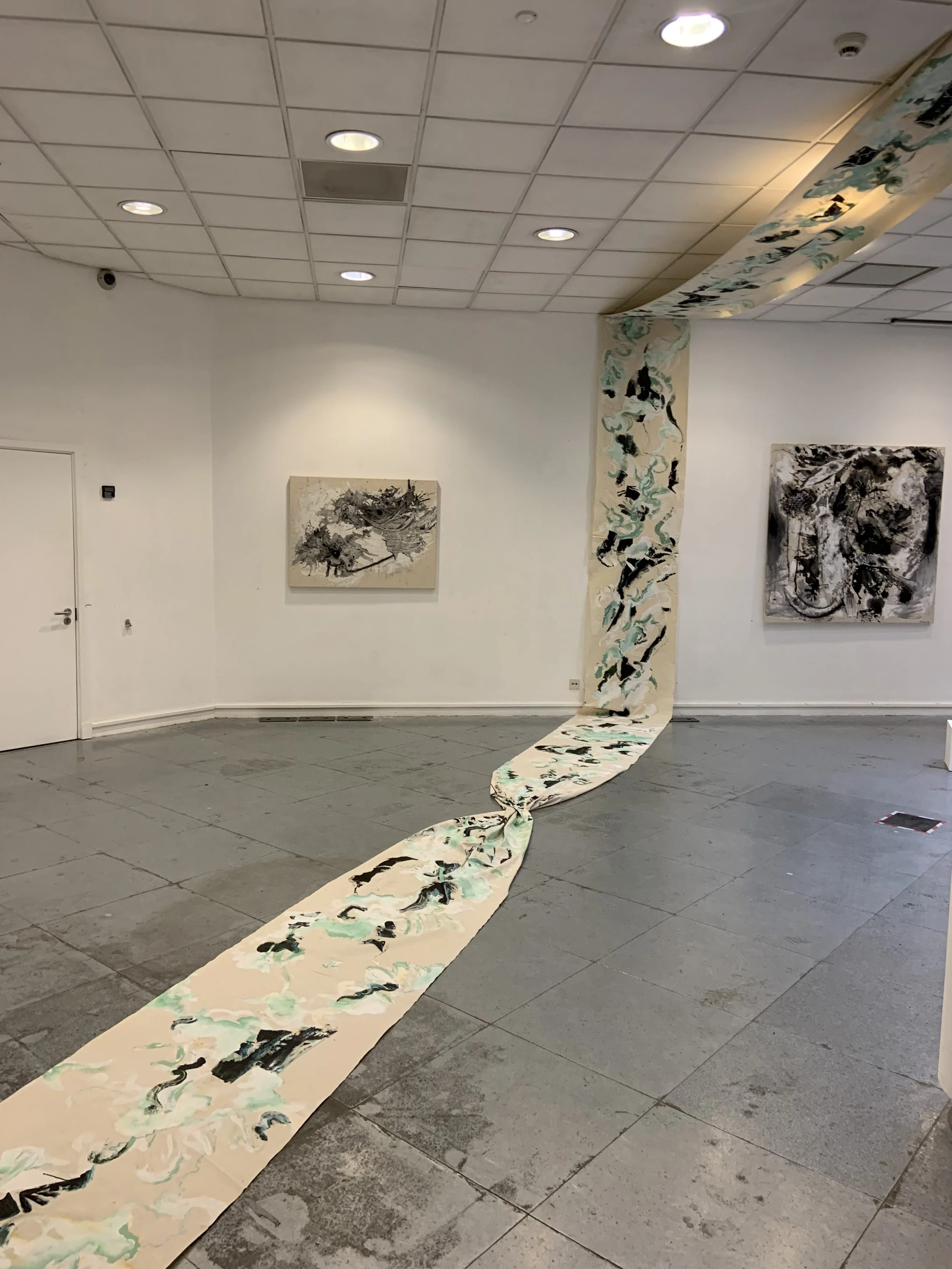
Installation view: ‘Möbius strip’, acrylic and oil pastel on canvas, Sahar Ravanbakhsh, 2024
The often-cited adage that a broken clock can be right twice a day, in the sense that dual-states can coexist all at the same time, is not lost on me.
“The idea started with a Möbius strip…it’s a closed circle that one side is flipped and the behind and the front exist at the same time.”, Sahar explains, describing Möbius strip, (2024) her partially suspended, 16-metre canvas installation-painting that traverses the ceiling and floor of the gallery’s interior, in what was originally conceived as a continuous loop, for this exhibition the installation has now been ‘cut’ reoriented in a vertical line extending from the ground to the sky.
The knot in the middle is gathered - twisted and held at a single point of tension - this recent body of work is best understood as an evolution of Ouroboros, the ancient insignia of a snake eating its tail. The transition to Möbius Strip initially appears as a mathematically calculated fine-tuning, hinged on the idea of the ‘ideal state’ – happiness or heaven which she felt was always out of reach - “My whole life was cut,” she reflects, referencing recent events in Iran and when she lost communication with her family. Yet this break does not produce an exit from the loop; rather, it transforms its orientation.
Like tracing a line, the pursuit never ends; one simply returns to the same point in this framework, the ascent offers the promise of paradise, but when the connection is cut there is also collapse. “You’re still in the circle,” she notes. The “in-between” acts as a condition of perpetual continuation without resolve – a rolling loop in which paradise never lasts. This ritualistic process privileges refinement over immediacy.
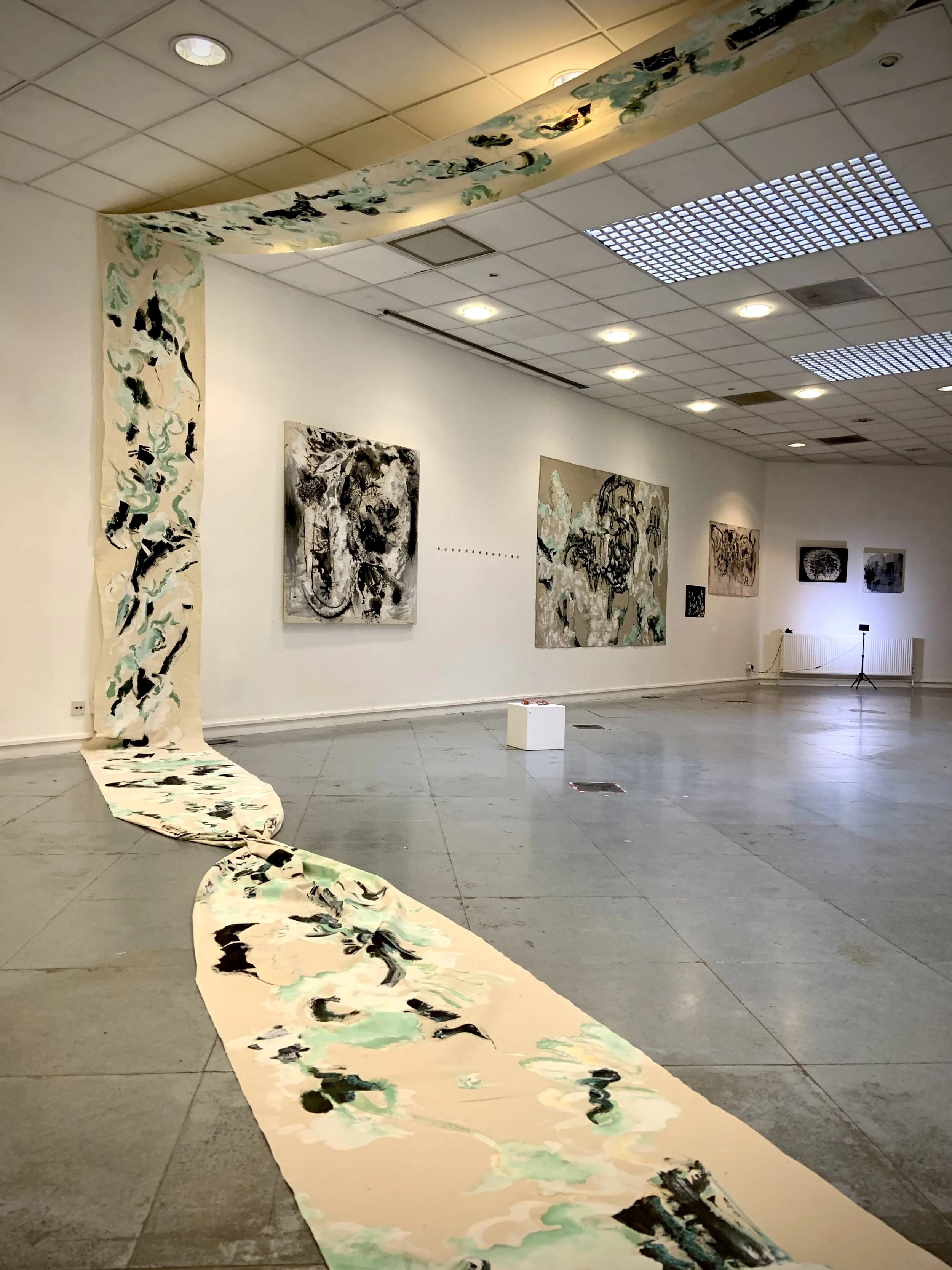
Installation view:‘Möbius strip’, acrylic and oil pastel on canvas, Sahar Ravanbakhsh, 2024.
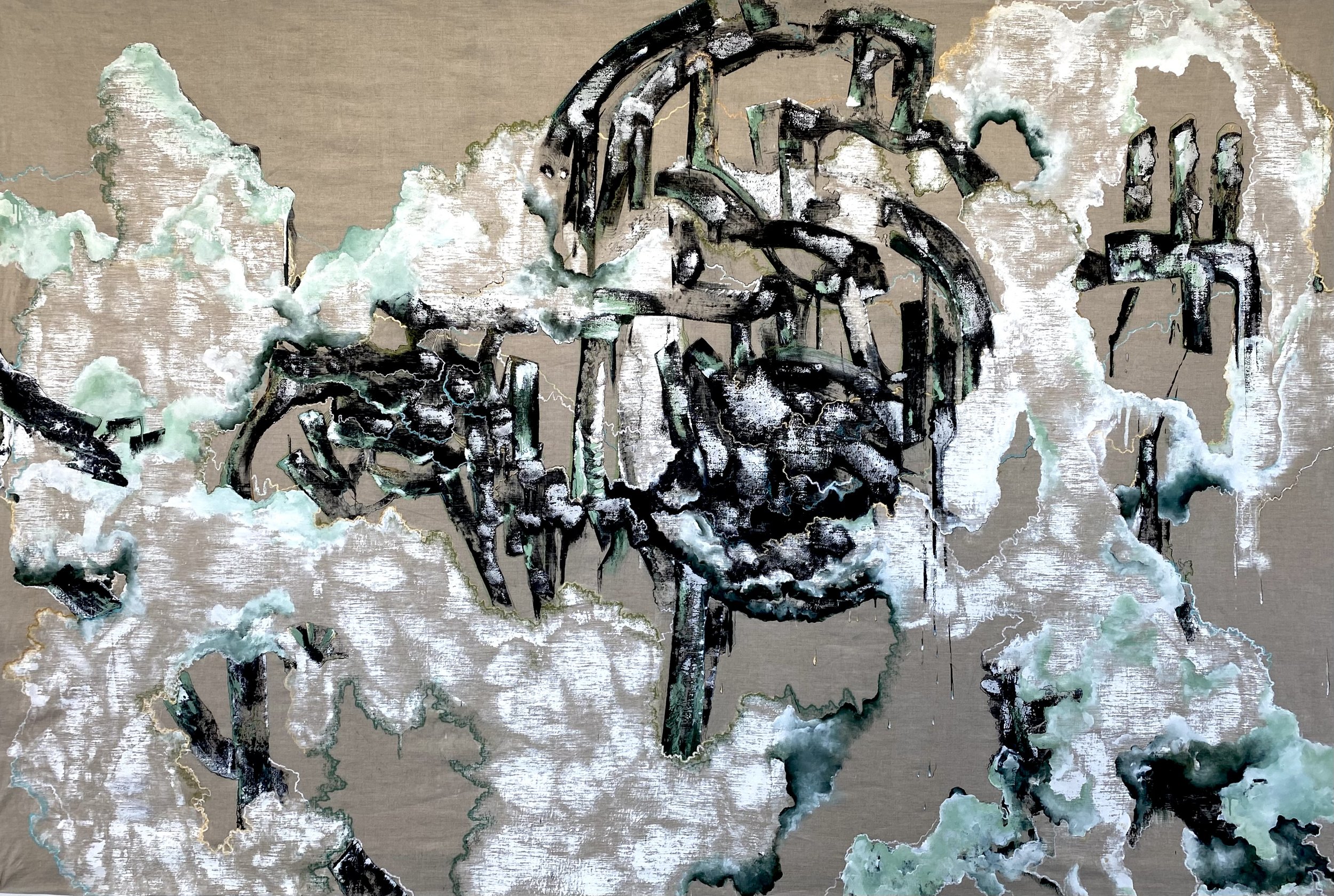
‘Fragment of the strip, Möbius strip’, acrylic, ink and pastel on canvas, Sahar Ravanbakhsh, 2024
Now ‘Fragment of the strip, Möbius strip, (2024) painting speaks for itself and rewards the transcript considerably.
Sahar is governed by a disciplined methodology drawing on her formal training in Chinese and Persian watercolour traditions. She has further adopted a principle of irreversibility: each colour is applied in single, constant application without revision. The canvas becomes a temporal record of discrete emotional state. Black is not merely a hue but a duration – an immersion carried the whole way yielding to the next colour application - enter green and white.
Three of the works in this series find their place on the wall all iterations of Möbius strip - Sahar has chosen to continue to remain with a limited colour palette: the white is suggestive of the skyline airy, and translucent, while also reflecting onto a black provisional structure arising into perspective. Up close, the clouds dissolve into the black and green in perfect synergy – The common occurrence of green has become synonymous with the way London makes her feel after migrating to the United Kingdom two years ago.
These are not incidental but environmental absorption: the effect of a new city filtering in the fibres of the work. One is not invited to resolve the image but to experience what the artist calls “creation… and destruction… happening at the same time.” This reasoning resonates with the longue durée of imperial rise and collapse.
Liminal…but not spaces demonstrates what happens when three artists operate within a shared vocabulary, arrive at a tacit alignment; audiences will not be off-clipped into the unknown, there is no hum-buzz or dizzying formaldehyde yellow. Though their practices triangulate; persistently in the in-between each exploring the threshold through their distinct approaches.
Aida’s introspection is heavily rooted in personal narrative and an ongoing grapple with visibility – suggesting that her relationship with painting is something which has a long horizon. Sahar, by contrast structures her inquiry through a quasi-mathematical framework where continuity never ceases and Kiana fires her ideas into materiality link by link.
Liminal, Koppel ANNEX, London, 04 June - 11 June 2026